Isaac Newton was the only son of a Lincolnshire farmer, also named Isaac Newton, who died three months before the boy was born. The infant was small and frail, and his mother, Hannah Ayscough, later remarried and moved away, leaving him in the care of his grandmother. He attended the King's School in Grantham, where he showed a gift for mechanical devices, and entered Trinity College, Cambridge, in 1661. He graduated in 1665 and stayed on as a fellow, but plague closed the university that year, sending him to the family estate for two years of intense private study.
Those plague years, later called his "annus mirabilis," produced the core of his life's work. He developed a method of fluxions - what is now called calculus - experimented with prisms to show that white light is a mixture of colors, and began working out the laws of motion and gravitation. He returned to Cambridge in 1667 and was elected a fellow of Trinity; in 1669 he became the Lucasian Professor of Mathematics. In 1668 he built a reflecting telescope using a curved mirror instead of lenses, and he sent it to the Royal Society in 1671, which elected him a fellow in 1672. His first paper, on light and color, drew sharp criticism from Robert Hooke, and Newton grew reluctant to publish for years afterward.
It was Edmond Halley who persuaded Newton to write up his mechanics. The result, Philosophiæ Naturalis Principia Mathematica (1687), set out the three laws of motion and the principle of universal gravitation, explaining both falling bodies on Earth and the orbits of the planets. The Principia established classical mechanics and made Newton famous across Europe. He also became entangled in a long, bitter dispute with Gottfried Wilhelm Leibniz over who had invented calculus first.
Newton served as warden and then master of the Royal Mint from 1696, overseeing the recoinage of English currency and prosecuting counterfeiters. He was elected president of the Royal Society in 1703, published his major work on optics, Opticks, in 1704, and was knighted by Queen Anne in 1705 - the first scientist so honored for his work. He never married and was known for a secretive, intense temperament; he also devoted enormous effort to alchemy and to unorthodox theological study, subjects he kept largely private.
Newton died in 1727 and was buried in Westminster Abbey. His laws and mathematics dominated physics for more than two centuries, and his work remains the foundation of classical mechanics.
Isaac Newton was born on January 4, 1643. In Cardology (Destiny Cards), January 4, 1643 corresponds to the Ten of Spades, making the Ten of Spades his Birth Card.
In numerology, the name adds another layer to the birth-date profile. The letters of a person’s name are used to explore inner motivation, personality, expression, and the qualities they bring into relationships and everyday life. Explore how his original name Isaac Newton influences his life and personality.
Isaac Newton Quotes
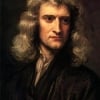
“I can calculate the motion of heavenly bodies, but not the madness of people.” - Isaac Newton
Famous Capricorn People
Discover famous Capricorn people, from actors and musicians to writers, athletes, and historical figures. Explore their birthdays and biographies, and see who shares the Capricorn zodiac sign.